
Introduction
Dutch elections are coming up on October 29, 2025. In a previous post, I assumed the next cabinet would likely contain VVD, GL-PvdA, D66 and CDA. However, politicians and journalist seem to disagree VVD leader Yeşilgöz and GL-PvdA’s Timmermans have both repeatedly stated they don’t want to govern together, which got me wondering: how realistic is it that they can avoid each other?
I also noticed this Manifold prediction market where people are betting on which parties will join the next government, and some of the probabilities looked off to me. Finally, I’ve been hearing some talk about strategic voting—people saying you should vote for party X instead of party Y to get outcome Z—and I wanted to figure out if any of that actually makes sense.
Methodology
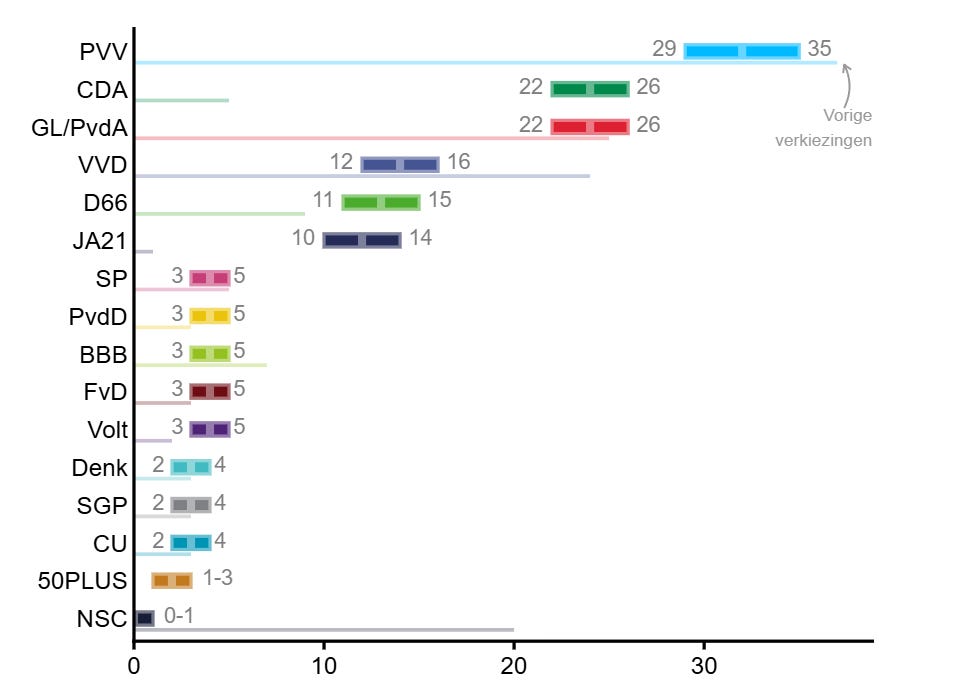
I’m using the Peilingwijzer for current seat estimates (taking the middle of each range). While polls show a lot can still change—Dutch elections have seen large last-minute swings—I wanted to understand which shifts actually matter for coalition formation.
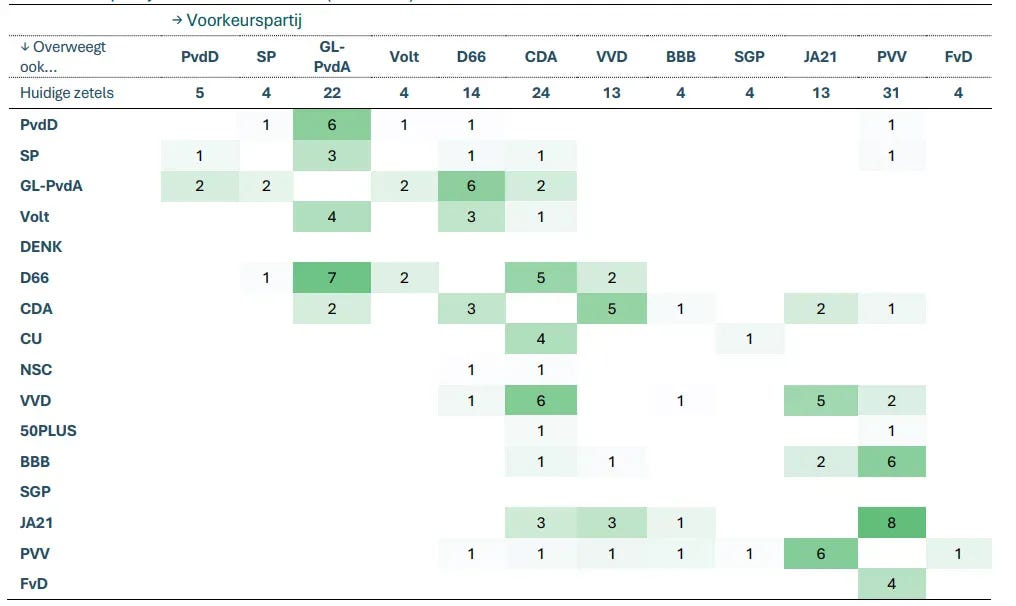
This is where the Ipsos poll becomes crucial. Ipsos asks voters which parties they’re considering voting for beyond their first choice Ipsos I&O created a matrix of potential voter flows between parties. The key insight: while the potential shifts are huge, many don’t actually change which coalitions are possible because they’re between parties that would likely govern together anyway. For example, voters switching between VVD and CDA doesn’t matter for whether a coalition with both will reach a majority or not.
With that being said, let’s do some math and some guessing, at the end these are also my thoughts. Maybe there are possible coalitions I miss (for example I truly rule out CDA working with PVV, that could be wrong) or moves I deem unlikely that will happen. It is possible that people switch parties at the end that are currently confident what they vote for
1. The PVV scenario
If PVV becomes the largest party (as current polls suggest), they will want to form a coalition. The first question is whether a majority is possible with parties that haven’t ruled out working with PVV.
Coalition Option 1: PVV + JA21 + BBB + FvD + SGP
Current polling: 32 + 12 + 4 + 4 + 3 = 55 seats (need 76 for majority) Gap to close: 21 seats
According to the Ipsos poll, almost everyone considering these parties is either already planning to vote for them or is considering the VVD. Even in the best-case scenario where:
All VVD voters switch to one of these parties (13 seats)
All other sympathetic voters also switch: 1 seat from CDA/Volt/GL-PvdA to PVV, 1 seat from D66 to BBB, and 2 seats from CDA to JA21 (6 seats total)
This only adds 13 + 6 = 19 seats, still 2 short of a majority.
Probability: Less than 1%
Coalition Option 2: PVV + JA21 + BBB + VVD
However, if PVV wins by a large margin, it might pressure VVD to negotiate despite their reluctance. VVD is unlikely to work with FvD or SGP, so the realistic coalition would be these four parties.
Current polling: 32 + 12 + 4 + 16 = 64 seats Gap to close: 12 seats
Maximum potential gains from voter shifts:
5 seats from CDA to VVD
2 seats from CDA to JA21
1 seat from CDA to PVV
1 seat from Volt to PVV
1 seat from GL-PvdA to PVV
1 seat from D66 to BBB
Total: 11 additional seats
This could happen if CDA collapses in a scandal or similar event, though they’d still be 1 seat short even with all sympathetic voters switching.
Adding SGP (3 seats) would bring the starting total to 67 seats, requiring only 9 additional seats—numerically more feasible but politically less acceptable to VVD. A minority cabinet with SGP support might be possible in this scenario.
Probability: Slightly less than 5%
Overall probability of any cabinet with PVV: At most 5%
2. Center-Right Cabinet
VVD leader Dilan Yeşilgöz has repeatedly expressed her desire for a center-right cabinet, explicitly excluding both the PVV and GroenLinks-PvdA. CDA voters also show a clear preference for coalition partnerships, with 66% favoring the VVD compared to only 36% supporting GroenLinks-PvdA
If the CDA becomes larger than GL-PvdA, they might attempt to form this “center-right cabinet.” However, D66 is unlikely to accept a coalition with BBB, which limits the possible configurations:
Option 1: VVD + JA21 + CDA + BBB
This seems highly undesirable for the CDA. With current polling at 14 + 12 + 24 + 4 = 54 seats, they would need 22 additional seats with no clear pathway to achieve this.
Probability: Less than 1%
Option 2: VVD + JA21 + CDA + D66 (possibly including CU)
D66 would strongly prefer a coalition with GL-PvdA if possible, but they’ve shown willingness in the past to accept being the most left-wing party in a coalition when no other options exist. Including CU would help mathematically but would complicate negotiations, as JA21 and CU aren’t a good match.
Current polling: 14 + 12 + 24 + 13 = 63 seats Seats needed: 13
According to the Ipsos poll, potential voter shifts include:
From PVV:
6 seats → VVD
8 seats → JA21
1 seat → CDA
1 seat → D66
From GL-PvdA:
2 seats → CDA
7 seats → D66
From other parties:
2 seats from Volt → D66
1 seat from BBB → VVD
1 seat from BBB → JA21
It’s unlikely all these shifts would occur simultaneously. However, this coalition could materialize if:
Many PVV voters shift to VVD or JA21 at the last moment, realizing PVV’s coalition chances are minimal (note: there may be significant overlap between PVV voters considering JA21 and those considering VVD, so this alone won’t be sufficient)
D66 performs very well at GL-PvdA’s expense, making a GL-PvdA coalition less viable due to poor performance
If we model these as two independent events, each with a 33% probability, this yields approximately a 10% probability, which seems somewhat generous. If we also include the scenario in which the 3-4 seats of CU are the difference, and they accept a coalition with Ja21, we might get to 15%.
3. GL-PvdA
In the remaining scenarios where PVV doesn’t govern, GL-PvdA will almost certainly be essential to forming a stable majority. Their preferred option would be a fully left-wing coalition:
Full Left Coalition: GL-PvdA + D66 + PvdD + Volt + DENK + SP
Current polling: 24 + 13 + 4 + 4 + 3 + 4 = 52 seats Gap to close: 24 seats
This has no realistic pathway to majority.
Probability: 0%
The Core Three-Party Base
All realistic alternatives must include at minimum: GL-PvdA + CDA + D66
Current polling: 24 + 24 + 13 = 61 seats
Based on Ipsos polling, this trio will likely end up between 50 and 74 seats. They’re more likely to gain than lose seats due to voters consolidating behind larger parties near election day, especially if VVD performs poorly and progressive voters choose GL-PvdA/D66 over smaller parties like Volt, PvdD, or SP. However, a modest gain seems more probable than a large one, as individual party performance will vary.
From here, three main scenarios emerge:
Scenario 1: Minority Government or Small Left Partners
If the core three parties reach the upper end of their range (around 70+ seats), they could form a minority government or add small left-wing parties like CU (3 seats), Volt (4 seats), or SP (4 seats). However, CDA might resist this configuration, preferring to work with VVD instead.
Probability: ~10%
Scenario 2: The Unwanted Grand Coalition with VVD
The most likely scenario involves adding VVD to form: GL-PvdA + CDA + D66 + VVD
Current polling: 24 + 24 + 13 + 14 = 75 seats (just 1 short of majority)
Despite Yeşilgöz repeatedly calling such a coalition “very unstable and undesirable“ and saying she doesn’t “see it happening,” the mathematics are compelling. With only 1 seat needed, this coalition has strong odds of reaching majority through normal polling variation. If they fall slightly short, CU could provide support. VVD’s long history as a coalition party makes them the more natural partner compared to JA21.
Probability: ~40%
Scenario 3: JA21 Replaces VVD
If VVD performs so poorly that the party is in disarray, they may prefer opposition to “regroup” rather than joining a coalition with left-wing parties—which could be political suicide for them. In this scenario, GL-PvdA + CDA + D66 + JA21 becomes the fallback.
Current polling: 24 + 24 + 13 + 12 = 73 seats (3 short of majority)
As VVD loses seats, JA21 typically gains them, making this coalition increasingly viable. While GL-PvdA and JA21 strongly dislike each other, they may be forced to cooperate or face new elections (unprecedented in Dutch history).
Probability: ~15%
Scenario 3: An even Grander Coalition
If the big parties do poorly this coalition might fall short in a way only Ja21 can fix, in this case the only possible coalition might be GL-PvdA + CDA + D66 + VVD + JA21
Current polling: 24 + 24 + 13 + 14 + 12 = 87 seats, it seems unlikely that this will lose a majority. While these coalition talks would be long and hard, it could be the only option
This is also the only coalition mentioned that has a majority in the first chamber, although GL-PvdA + CDA + D66 + VVD + CU is also a majority
Probability: ~15%
4. If all else fails
Things could get really chaotic and (as never happened before) maybe no coalition agreement is reached and new elections are held, but those scenarios seem both unlikely and are not included in the manifold market
5. Manifold market
There is a manifold market that can be used to make election forecasts, they are asking the probability of different parties ending up in government. My forecasts don’t really tackle the small parties, there are multiple scenario’s in which they could be needed or not depending on the exact outcome of the elections so I keep them outside the scope
For the big parties we can see the following probabilities
CDA: ~95% (in scenarios 3, 4, 6, 7, 8, 9)
D66: ~95% (in scenarios 4, 5, 6, 7, 8, 9)
GL-PvdA: ~80% (in scenarios 5, 6, 7, 8, 9)
VVD: ~75% (in scenarios 2, 3, 4, 7, 9)
JA21: ~55% (in scenarios 1, 2, 3, 4, 8, 9)
PVV ~5% (in scenarios 1,2)
At the moment of writing GL-PvdA, D66 and Ja21 seemed underprized given my forecast and PVV overprized, so I made trades accordingly
6. Strategic voting
Based on this forecasting the following strategic voting strategies make sense to me:
If you want one of the PVV coalitions I don’t think there is much you can do except the obvious thing of not voting for a party that ruled out PVV
If you don’t want one of the PVV coalitions and you are debating Ja21/VVD/CDA probably vote CDA
If you want a ‘centrum right’ coalition and are considering PVV and Ja21/VVD, Ja21 is probably a better bet, this also does not really change the likelihood of a PVV coalition but if your first choice is a PVV coalition and your second choice a coalition without GL-PvdA Ja21 is probably your best bet. A lot of PVV voters voting strategically for Ja21 or VVD is likely necessary for GL-PvdA to be outside the coalition.
If you would prefer a CDA-GL/PvdA-D66 coalition over a Ja21-VVD-CDA-D66 coalition and are debating between D66 (or CDA) and GL-PvdA you should probably vote GL-PvdA, especially if there are signs PVV voters might make strategic moves or PVV is losing in the polls. D66 winning from GL-PvdA is probably necessary for GL-PvdA to be outside the coalition.
If you would prefer a CDA-GL/PvdA-D66 coalition without the VVD/Ja21 or at least not both to one with you should probably vote for one of those three parties instead of Volt/PVDD/CU/SP
I don’t think any other strategic moves make sense, basically if you are left-wing GL-PvdA seems like the strategic choice, if you are right-wing and like the PVV Ja21 seems like the most strategic choice and if you are right-wing and like the PVV less than GL-PvdA CDA seems like the most strategic choice.
Off course, not voting strategically is totally legitimate, I’m not advocating for voting strategically, just that if you plan on doing so to do something that makes sense.
Conclusion
After writing this I think VVD and GL-PvdA avoiding each other is a bit more likely than I thought going in, but most of that is because I could see a scenario where Ja21 takes the role of VVD. Fundamentally, that does not change that much, tho it does not make the coalition more coherent or more stable, and I don’t think it’s what either party leader has in mind when they say they don’t want to work with each other.
I also think strategically voting for GL-PvdA makes more sense than I thought going in, if you are on the left, how big GL-PvdA is really matters a lot for which coalitions are likely and possible.
The most likely scenario is a grand coalition that is ideologically very diverse (and maybe unstable) with the opposition consisting of mostly extreme-right parties and no classic governing party. This makes me not that worried about the next election, but *very* worried about the election afterwards, what happens if the coalition becomes extreme unpopular (like Labor in the UK) - people don’t have anywhere to go except to the extremes (or maybe a new party will arise).
If you feel like I made major errors in my forecasting, not considering certain coalitions carefully enough, or having my percentages not match my story, please say so! Would love to learn :)